
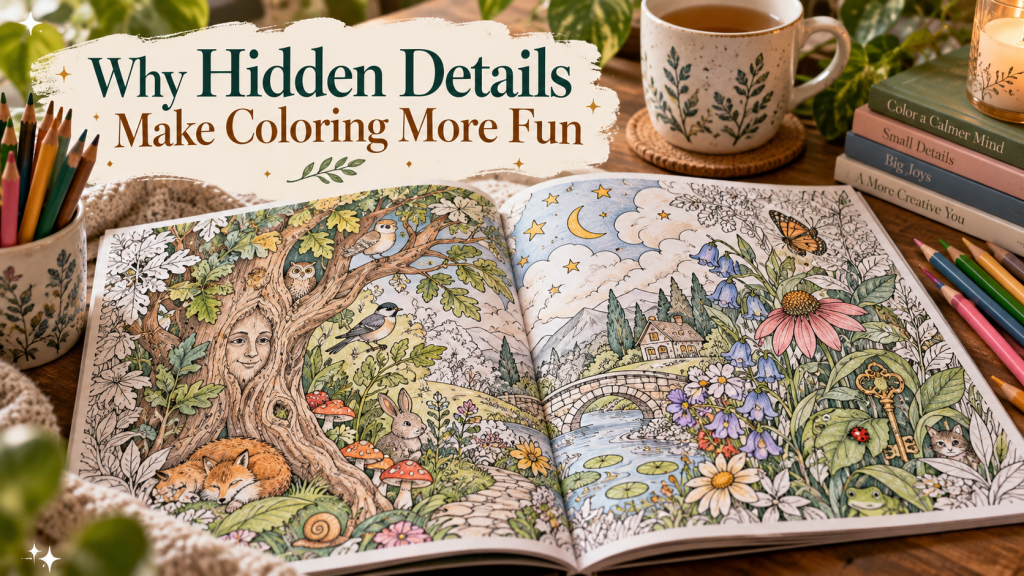
At first glance, a coloring page might look like a collection of flowers, trees, rooms, patterns, or everyday objects waiting for color.
But then you notice something.
A tiny bird tucked into the leaves.
A face hidden in the bark of a tree.
A miniature doorway where you weren’t expecting one.
A key woven into a garden.
Suddenly, you’re not just coloring anymore. You’re looking closer.
And that is exactly what makes coloring pages with hidden details so much fun.
Coloring Becomes More Than Filling in Spaces
Traditional coloring is already relaxing because it gives your hands something creative to do without requiring you to start with a blank page.
Hidden-detail coloring adds another layer to the experience.
Instead of immediately seeing everything the page has to offer, you discover parts of the illustration as you work your way through it.
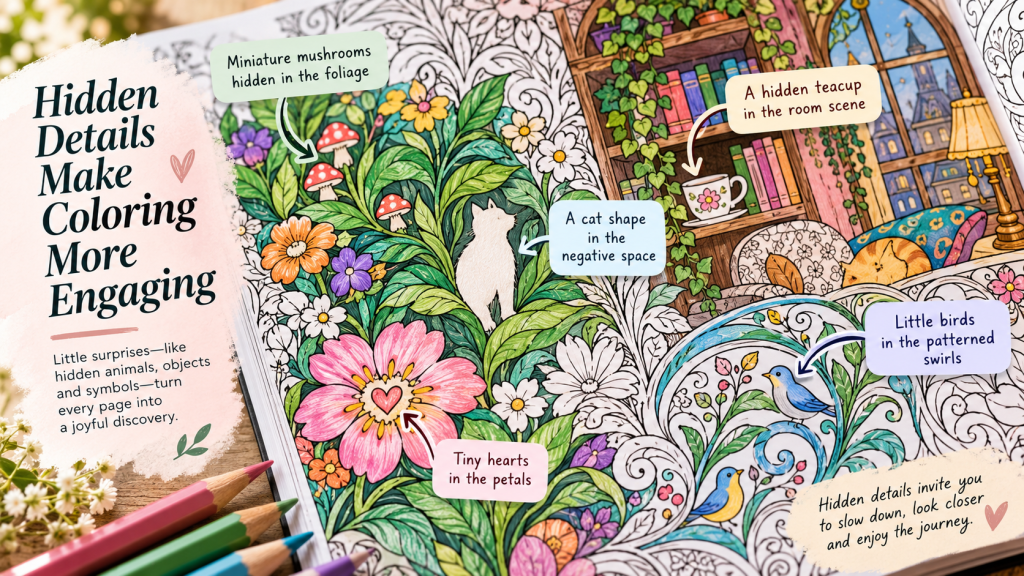
You may begin coloring a flower and realize there is a tiny heart hidden inside the petals. A group of leaves might reveal the silhouette of an animal. A seemingly ordinary bookshelf might contain a miniature world tucked between the books.
That small element of surprise keeps the page interesting from beginning to end.
It turns coloring into a combination of creativity, exploration, and discovery.
Explore more adult coloring books from Unwind & Flow
Hidden Details Encourage You to Slow Down
One of the reasons many adults enjoy coloring is simple: it gives us permission to stop doing ten things at once.
Hidden details encourage that even more.
When an illustration contains unexpected elements, you naturally spend more time studying the page.
You begin noticing shapes, patterns, tiny objects, and unusual little scenes that might have been easy to overlook.
There is no rush to finish.
In fact, the slower you go, the more you often find.
That makes these pages especially enjoyable when you want a creative activity that pulls your attention away from screens, notifications, and everything competing for your attention.
There’s a Little Reward Every Time You Discover Something
Finding something unexpected creates a tiny moment of satisfaction.
It’s the coloring-book equivalent of saying:
Wait… was that there the whole time?
That feeling is part of what makes hidden-detail pages so engaging.
You aren’t simply moving from one section to the next. You’re wondering what else the artist may have tucked into the scene.
A page might contain:
- tiny animals hidden among flowers
- unusual objects blended into architectural details
- miniature scenes inside everyday objects
- faces or shapes formed by negative space
- small symbols hidden within patterns
- unexpected doors, windows, paths, or creatures
Not every hidden detail has to be difficult to find. Some may become obvious as soon as you begin adding color, while others may only appear after you’ve spent quite a bit of time with the page.
That variety is part of the fun.
The Page Changes the Longer You Look at It
This is one of my favorite things about this style of coloring.
A great hidden-detail illustration can look completely different after you’ve spent twenty minutes with it.
What initially looked like a tree may suddenly contain an entire tiny world.
An ordinary teacup might reveal a miniature landscape.
A bookshelf may contain a doorway.
A garden may have animals, keys, stars, faces, mushrooms, and tiny houses woven throughout the plants.
That idea is at the heart of the Beautifully Strange style of coloring pages — scenes that seem familiar at first but become a little more unexpected the longer you look.
Discover the Beautifully Strange coloring book collection
Hidden Details Keep Detailed Pages From Feeling Repetitive
Intricate coloring books can be beautiful, but detail alone doesn’t automatically make a page interesting.
There is a big difference between coloring dozens of repetitive shapes and discovering something new as you move around an illustration.
Hidden elements give the details a purpose.
Instead of thinking, That’s another leaf I need to color, you may suddenly realize the leaves are surrounding the outline of a fox.
Instead of simply coloring another window, you discover something strange happening behind it.
That small storytelling element makes detailed coloring feel less mechanical and much more imaginative.
You Get to Decide What to Emphasize
Another fun part of hidden-detail coloring is deciding how obvious you want the discoveries to become.
Suppose a tiny key is hidden among a group of leaves.
You could color the key in a bright metallic gold so it immediately stands out.
Or you could use similar colors to the surrounding foliage so it remains something people have to look closely to find.
The same thing works with hidden animals, miniature doors, unusual objects, or secret patterns.
You become part of the illusion.
Color isn’t simply decorating the page — it helps determine what the viewer notices first and what remains hidden.
If you’re experimenting with pencils, markers, layering, and blending techniques, you may also enjoy our guide to choosing coloring supplies for adult coloring books.
They Bring a Little Storytelling Into Coloring
Hidden details often make you start asking questions.
Why is there a tiny door in that tree?
Where does that staircase go?
Why is there a miniature house inside a suitcase?
Who left the key hidden in the flowers?
You don’t necessarily need an answer.
Your imagination gets to fill in the blanks.
That’s one of the reasons surreal and whimsical coloring pages can be so satisfying for adults. They aren’t simply pictures to complete. They feel like small worlds you get to explore.
And every person may imagine a completely different story.
They’re Fun to Color More Than Once
A page with hidden elements can also have more replay value than a straightforward design.
The first time, you may focus on discovering everything.
The next time, you might choose an entirely different color palette.
You might make the hidden objects bold and obvious in one version and nearly invisible in another.
Printable digital coloring pages are especially fun for this because you can print the same design again and experiment without worrying about getting it “wrong.”
There really isn’t a wrong version.
Why We Love the Unexpected
Coloring doesn’t have to be serious to be meaningful.
Sometimes the best part is simply finding something that makes you smile.
A frog where you weren’t expecting a frog.
A tiny room inside an old clock.
A cat hiding in the negative space between flowers.
A miniature world inside something completely ordinary.
Those discoveries add curiosity and playfulness to an activity that’s already creative and relaxing.
And perhaps that’s what makes this type of coloring so enjoyable.
You’re not just coloring what you see.
You’re discovering everything you almost didn’t see.
So the next time you open a coloring page, don’t be too quick to start.
Look once.
Then look again.
There just might be something beautifully strange hiding in plain sight.


Leave a Reply