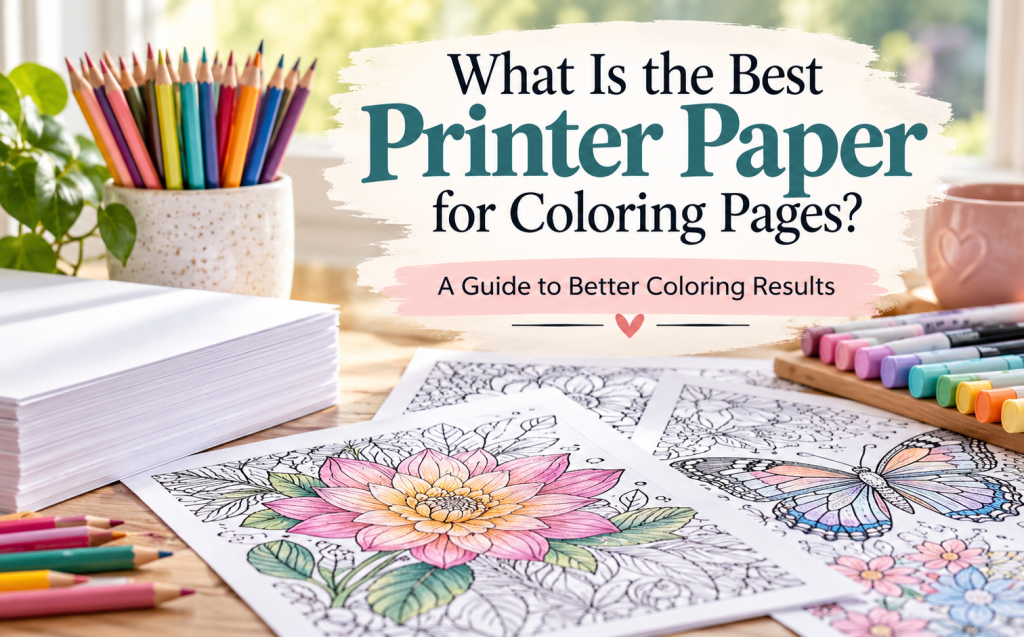
Colored pencils, markers, gel pens, or crayons? Here’s how to choose the perfect paper for your favorite coloring supplies.
You’ve found the perfect coloring page, downloaded it, and you’re ready to start coloring. But before you hit print, there’s one thing worth considering: the paper.
Not all printer paper is created equal, especially when it comes to coloring.
The right paper can make your colored pencils blend more smoothly, help your colors look more vibrant, and reduce frustrating problems like bleeding, buckling, and tearing.
And the good news? You don’t need expensive specialty paper to get beautiful results.
Whether you’re printing intricate adult coloring pages or fun designs for kids, here’s what you need to know about choosing the best paper for coloring.
Our Favorite All-Around Choice: 32 lb Bright White Printer Paper
If you’re looking for one paper that works well for most coloring projects, 32 lb bright white printer paper (approximately 120 gsm) is our top recommendation.
It’s thicker and more substantial than ordinary printer paper, but it still works with many home printers.
Here’s why we love it:
- Smooth coloring surface: Great for colored pencils, gel pens, and fine-tip markers.
- Bright white finish: Helps printed outlines look crisp and colors appear vibrant.
- Better durability: Holds up to repeated coloring and erasing better than standard copy paper.
- Less show-through: Its heavier weight helps minimize marks showing on the opposite side.
- Easy to use: No need to invest in professional art paper for everyday coloring.
Two excellent options to look for are HP Premium32 and Hammermill Premium Color Copy 32 lb paper.
Both are worth considering if you regularly print downloadable coloring pages.
Best Printer Paper for Different Coloring Tools
Your favorite coloring medium makes a difference when choosing paper. What works beautifully for colored pencils might not be the best option for alcohol markers.
Choosing the right paper is only half the equation. Your coloring supplies matter, too. Read our guide to choosing between colored pencils, markers, and gel pens to discover which tools work best for your coloring style.
Here’s a quick guide:
| Coloring medium | Best paper choice |
|---|---|
| Colored pencils | 28–32 lb matte paper |
| Crayons | 20–24 lb printer paper |
| Gel pens | 32 lb smooth paper |
| Water-based markers | 32 lb paper or 65 lb cardstock |
| Alcohol markers | Specialty marker paper or smooth cardstock with protective backing |
| Mixed media | 65 lb cardstock, if printer-compatible |
Best Paper for Colored Pencils
Colored pencils are one of the most popular choices for adult coloring books, and paper texture plays a big role in how they perform.
A smooth, heavyweight printer paper, such as 32 lb paper, works beautifully for everyday coloring. It allows you to build layers of color and create soft gradients without the paper feeling too flimsy.
If you enjoy advanced blending and layering, consider paper with a little more texture, often called tooth. That subtle texture gives pencil pigment something to grip.
Our recommendation: Start with 32 lb matte printer paper. If you love detailed shading and blending, experiment with slightly textured drawing paper that’s compatible with your printer.
Best Paper for Crayons
Crayons are wonderfully forgiving, which makes them perfect for kids’ coloring pages and casual creative afternoons.
Standard 20–24 lb printer paper is generally all you need. Crayons don’t usually create the moisture or bleed-through issues associated with markers.
If you’re printing coloring pages for younger children, there’s no need to spend extra money on premium paper.
Our recommendation: Regular bright white printer paper works just fine!
Best Paper for Gel Pens
Gel pens create beautiful, vibrant details, especially when you’re adding metallic accents, bright colors, or intricate patterns.
Because gel ink sits on the surface before drying, a smoother paper is generally preferable.
32 lb smooth printer paper is an excellent starting point. It gives you a sturdy surface while helping fine details remain crisp.
Our recommendation: 32 lb smooth bright white paper. Allow gel ink to dry before touching or layering over it to prevent smearing.
Best Paper for Water-Based Markers
Water-based markers are popular for coloring because they’re easy to use and available in so many colors.
However, applying lots of ink to thin paper can cause wrinkling, pilling, or bleeding.
A heavier 32 lb paper is a good choice for lighter marker applications.
If you enjoy blending or applying several layers of color, 65 lb cardstock can provide a sturdier surface, although it isn’t completely resistant to moisture.
Our recommendation: Start with 32 lb paper for light coloring and move up to cardstock if you tend to use more ink.
Best Paper for Alcohol Markers (Ohuhu, Copic, and Similar Brands)
Alcohol markers are a little different.
They’re known for their beautiful blending capabilities and vibrant, smooth color. But they also have a habit of bleeding through paper, sometimes even thick paper.
If you love alcohol markers, consider specialty marker paper designed for alcohol-based ink.
Smooth cardstock can also work, but it doesn’t guarantee that ink won’t bleed through.
Marker bleed-through can be frustrating, even when you’re using thicker paper. For more practical ways to protect your artwork, check out our guide on how to prevent markers from bleeding through coloring book pages.
Important tip: Always place a protective sheet beneath the page you’re coloring, especially when using alcohol markers. A nonporous protective barrier is ideal for safeguarding your table or the pages underneath.
Our recommendation: Specialty alcohol-marker paper for the best blending experience, with protective backing to keep ink off your work surface.
Our Top Three Paper Recommendations for Printable Coloring Pages
If you’re shopping for paper, these are three options worth considering.
1. HP Premium32 Printer Paper — Best Overall
A versatile 32 lb paper with a bright white, smooth finish. It’s an excellent everyday option for printable coloring pages, especially when using colored pencils and gel pens.
Why we love it:
- Bright white surface makes colors pop.
- Thick enough for everyday coloring projects.
- Smooth finish for detailed designs.
- Compatible with many home printers.
Best for: Colored pencils, gel pens, fine-tip pens, and general coloring.
2. Hammermill Premium Color Copy 32 lb — Another Great Everyday Choice
A high-quality, heavier printer paper that produces crisp printed linework. It’s a good choice for detailed coloring designs and anyone who prints coloring pages regularly.
Why we love it:
- Excellent brightness for clean-looking pages.
- Smooth surface for detailed coloring.
- More substantial feel than standard printer paper.
- Great for intricate printable artwork.
Best for: Adult coloring pages, colored pencils, and gel pens.
3. Neenah Bright White Cardstock — Best for a Heavier Feel
For coloring enthusiasts who prefer a substantial page, bright white cardstock is worth trying.
Look for a smooth finish and a weight your printer can handle.
Cardstock is especially useful for coloring pages you want to display, frame, or turn into handmade cards.
Why we love it:
- Sturdy feel for finished artwork.
- Good for projects you plan to display.
- Handles repeated coloring better than lightweight paper.
- Great for creative crafts.
Best for: Decorative coloring pages, card-making, and mixed-media projects.
Does Paper Weight Really Matter?
Absolutely!
Most everyday printer paper weighs around 20 lb (75 gsm). It’s affordable and perfectly adequate for printing documents, but it can feel a little thin for detailed coloring.
Heavier paper generally feels sturdier, stands up better to erasing, and can reduce show-through.
Here’s how common printer paper weights compare:
| Paper weight | What it’s best for |
|---|---|
| 20 lb / 75 gsm | Everyday printing and crayons |
| 24 lb / 90 gsm | Basic coloring pages |
| 28 lb / 105 gsm | Colored pencils and light marker use |
| 32 lb / 120 gsm | Premium everyday coloring pages |
| 65 lb cover cardstock / approximately 176 gsm | Sturdier coloring projects and display pieces |
One thing to keep in mind: paper weight can be confusing because printer paper and cardstock use different weight classifications.
A 65 lb sheet of cover cardstock isn’t necessarily almost twice as thick as 32 lb printer paper.
Comparing gsm (grams per square meter) is the easiest way to understand the difference.
Before purchasing heavier paper, check your printer’s recommended paper-weight limits. Not every home printer can comfortably feed cardstock.
Inkjet vs. Laser Printers: Which Is Better for Coloring Pages?
Here’s another question that comes up frequently: does your printer type matter?
Both inkjet and laser printers can produce excellent coloring pages.
Inkjet Printers
Inkjet printers are common in homes and generally produce sharp outlines.
However, some printer inks can smear or run when water-based markers are applied, so it’s a good idea to test a small area before coloring.
If you’re using an inkjet printer, allow printed pages to dry completely before adding color.
Laser Printers
Laser printers use toner that’s fused to the paper with heat.
This can make printed outlines more resistant to water-based coloring materials, although results still depend on the toner and paper.
Laser printers are often a great option if you regularly print large numbers of black-and-white coloring pages.
Our recommendation: Use whichever printer you already own. Both can produce beautiful coloring pages when paired with the right paper.
Five Tips for Printing Better Coloring Pages at Home
A few small adjustments can make your coloring experience even better.
1. Choose Bright White Paper
Bright white paper provides a clean background and makes colors stand out.
It’s especially helpful when printing detailed illustrations with fine outlines.
2. Print at High Quality
Use your printer’s best-quality setting when you want crisp outlines and fine details.
For high-resolution printable coloring pages, make sure you’re printing from the original PDF rather than a low-resolution screenshot.
3. Select the Correct Paper Setting
Match your printer settings to the paper you’re using.
Many printers have settings for plain paper, heavyweight paper, or cardstock.
Choosing the appropriate setting can help improve print quality and paper feeding.
4. Print on One Side
Whenever possible, print your coloring pages on just one side of the paper.
This is particularly important when using markers or creating artwork you might want to frame.
Single-sided printing also gives you the freedom to experiment without worrying about affecting artwork on the back of the page.
5. Test Your Favorite Supplies
Before printing an entire collection of coloring pages, try one page with your favorite pencils, pens, or markers.
Test how easily the colors blend, whether ink bleeds, and how the paper feels.
A little experimentation can save paper, ink, and frustration later.
Why We Love Printable Coloring Books
One of the best things about digital coloring books is having the freedom to choose your own paper.
You aren’t limited to the paper used in a traditionally printed book. Instead, you can select the surface that works best with your favorite supplies.
Love colored pencils? Print on premium matte paper.
Prefer alcohol markers? Try specialty marker paper.
Want to frame your finished artwork? Print on heavier cardstock.
And if you want to color the same design again with an entirely different palette, simply print another copy for personal use, subject to the download’s license.
There’s also something wonderful about choosing a coloring page that fits your mood.
Some days you might want something calming and repetitive. Other days, you might be in the mood for a whimsical illustration filled with unexpected details.
If you’re not sure what to color next, take a look at our guide to finding the right coloring book for your mood.
That’s part of what makes printable coloring pages so much fun. You have the freedom to experiment, personalize, and create something entirely your own.
Final Thoughts: What’s the Best Paper for Coloring?
If you want beautiful results without overcomplicating things, 32 lb bright white printer paper is our favorite place to start.
It’s sturdy, smooth, widely available, and works well with most everyday coloring supplies.
But don’t be afraid to experiment.
Some people love the smooth glide of colored pencils on premium printer paper, while others prefer the textured feel of drawing paper.
You might even find yourself using different papers depending on the design and the supplies you’re working with.
The best coloring paper is ultimately the one that feels right for the way you create.
And remember, coloring isn’t about perfection. It’s about slowing down, enjoying the process, and giving yourself a little creative freedom.
Ready to put your new paper to the test?
Explore our collection of printable coloring books and find beautiful designs you can print at home on the paper that works best for you.
Happy coloring!
Unwind & Flow Coloring Books — A little creativity. A little calm. A lot of possibilities.


Leave a Reply